English at West Felton…
Competent English skills are essential for progress across and throughout the curriculum and to prepare children effectively for adult life, preparing for life in all its fullness.
All teachers and teaching assistants have a responsibility to develop children’s competence in reading, writing, speaking and listening to ensure that pupils become competent users of language, and can access the curriculum effectively and achieve their potential.
West Felton CofE Primary School:
- Recognises the effect that a confident, fluent and coherent understanding of English will have on a children’s progress, both inside and outside of the school environment.
- Understands how a strong grounding in English will impact the future learning and development of a child in all aspects of their life
- Provides a balanced and broad curriculum which encompasses writing practice, including handwriting, spelling, widening vocabulary, and writing for different styles, purposes, and audiences, as well as focusing on spoken English, reading, grammar and pronunciation.
- Ensures that all staff members are aware of planning, assessment, teaching and learning requirements for the English curriculum.
- Ensures that all children know how to plan, practise and evaluate their work.
- Ensures that all children understand all elements of English, as stated in the National Curriculum.
Statutory Requirements
Our teaching adheres to the statutory requirements as detailed in the following documents:
- DfE (2013) English programmes of study: key stages 1 and 2 https://assets.publishing.service.gov.uk/government/uploads/system/uploads/attachment_data/file/335186/PRIMARY_national_curriculum_-_English_220714.pdf
- DfE (2021) Statutory framework for the early years foundation stage https://assets.publishing.service.gov.uk/government/uploads/system/uploads/attachment_data/file/974907/EYFS_framework_-_March_2021.pdf
Teaching and Learning of English
- The English curriculum is delivered every single day, in various formats e.g. English lesson, Guided Reading, phonic session.
- Grammatical errors are corrected on written work by classroom teachers, and discussed orally with children where necessary.
- Classroom teachers and teaching assistants will use high-quality resources which effectively model English skills and demonstrate good practice.
- Children will be encouraged, by their classroom teachers, to discuss their English skills with their peers and with the whole class before beginning their written work.
- Children will be given sufficient time to discuss, plan and edit their work.
- In regards to handwriting, writing frames and scaffolds will be provided for pupils who are less confident, in order to develop their handwriting skills. (see specific handwriting section)
- To broaden pupils’ vocabulary and improve understanding, the following teaching methods will be implemented by classroom teachers:
- Spelling lists and key words to take home and practise.
- Using displays of key words linked to topics and subjects.
- Practising using the correct vocabulary orally.
- Dedicating lessons focussed on word patterns and choices.
- Encouraging the use of dictionaries and thesauruses.
- Reading a variety of examples of texts to explore new vocabulary.
- Providing one-to-one support, where necessary.
- Classroom teachers will encourage the development of speaking and listening through activities within each English lesson and throughout the curriculum and school life.
- Speaking and listening may be commented on where appropriate in pupils’ books, on Seesaw, with positive work/progress rewarded using reward stickers.
- Systems such as ‘collaborative group work’ structures are to be used to ensure active participation in group and class discussions.
- Pupils will often be provided with checklists to self-assess their work and the work of peers, so they can share ideas and evaluate work effectively.
- The classroom teacher, in collaboration with the subject leader, will ensure that every pupils’ needs are met by:
- Setting tasks which can have a variety of responses.
- Providing resources of differing complexity, according to the ability of the pupils.
- Utilising TAs to ensure that all pupils are satisfactorily supported.
Planning
Planning of the English curriculum is focussed on five core areas:
- Teaching children to read easily, fluently and with good understanding.
- Developing the habit of reading widely and often, for both pleasure and information, which in turn will develop an appreciation for our literary heritage.
- Children will acquire a wide vocabulary, an understanding of grammar and knowledge of linguistic conventions for reading, writing and spoken language.
- Children will write clearly, accurately and coherently, adapting language and style in and for a range of contexts, purposes and audiences.
- Ensuring children feel confident with discussion; children should be able to elaborate and explain clearly their understanding and ideas, in order to learn.
The school creates long-term, medium-term, and short-term plans for delivery of the writing curriculum – these are as follows:
- Long-term: includes the topics studied in each term during the key stage.
- Medium-term: includes the details of work studied during each term.
- Short-term: includes the details of work studied during each lesson.
Here is our West Felton CofE Primary LTP whole school writing
Assessment and reporting
Children will be assessed and their progression recorded in line with the school’s Assessment Policy.
Children aged between two and three will be assessed in accordance with the ‘Statutory framework for the early years foundation stage’ 2021, in order to identify each child’s strengths and identify any areas where progress is below the expected level.
An EYFS Profile will be completed for each pupil in the final term of the year in which they reach age five.
The progress and development of pupils within the EYFS is assessed against the early learning goals outlined in the ‘Statutory framework for the early years foundation stage’.
Throughout the year, teachers will plan on-going assessment opportunities in order to gauge whether pupils have achieved the key learning objectives.
Assessments will be undertaken in various forms, including the following:
- Talking to children and asking questions.
- Discussing children’s work with them.
- Marking work against the objectives.
- Children’s self-evaluation of their work and their peers’ work.
- Classroom assessments and statutory assessments.
For more information please see our Assessment Policy.
Poetry
This academic year, one of our SDP priorities is Poetry:
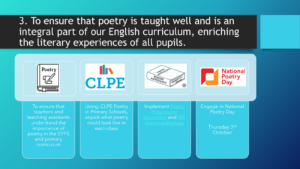
As part of this, we have developed a whole school anthology which the children will be exposed to throughout their time with us.